Quiet air compressors make pneumatic tools more practical in garages, workshops, and indoor job sites where noise matters. The right model balances sound level, tank capacity, airflow, portability, and duty cycle.
We selected 10 options ranging from compact one-gallon units to high-capacity 20-gallon compressors, so you can match your purchase to the tools and tasks you use most.
Best 10 Quiet Air Compressors Picks for 2026
Best Overall for Quiet Capacity

- 60 dBA operation for quieter indoor use
- 8-gallon aluminum tank with wheels
- Oil-free pump and 120 PSI maximum
Best For: Quiet workshop tasks needing extra tank capacity
Best for Trim Work
DEWALT DWFP55130 Quiet Compressor

- 3.0 SCFM at 90 PSI for nailer recovery
- 200 PSI maximum pressure
- Dual couplers and vertical or horizontal storage
Best For: Trim carpentry and compact nailer setups
Best Rugged Compact Pick

- 60 dB Quiet Series operation
- Protective roll-cage construction
- Oil-free 2-gallon design with 135 PSI maximum
Best For: Portable job-site use and intermittent tools
Best Fast-Recovery Compact Model

- 60 dBA operation for indoor projects
- 14-second listed recovery to 120 PSI
- 35-pound oil-free compressor with aluminum tank
Best For: Air brushing, inflation, and quick intermittent tasks
Best Ultra-Quiet Compact Pick
Metabo HPT EC28M 1-Gallon Compressor

- Very quiet 59 dB operation
- Lightweight 25.2-pound portable design
- Oil-free build with universal quick coupler
Best For: Portable nailing and low-noise DIY work
Best Portable Versatility Pick
Stealth SAQ-1234 2-Gallon Compressor

- Quiet operation as low as 60 dB
- 2.8 CFM at 40 PSI and 1.8 CFM at 90 PSI
- Oil-free design with safety protections
Best For: DIY inflation, nailing, airbrushing, and stapling
Best Large-Tank Workshop Pick
Quiet 5-Gallon Oil-Free Compressor

- 5-gallon tank with 2.8 CFM at 90 PSI
- Includes 25-foot hose and 13-piece accessory kit
- Wheels and oil-free design support easier ownership
Best For: Garage, workshop, nailing, and intermittent pneumatic-tool use
Best Compact Quiet Pick
Makita MAC320Q 3-Gallon Quiet Compressor

- 60 dB Quiet Series operation
- Oil-free, low-maintenance pump
- Portable roll-cage design
Best For: Indoor projects requiring compact, quieter operation
Best Large-Tank Value
California Air Tools 20020 20-Gallon Compressor

- 20-gallon steel tank
- 70 dB ultra-quiet operation
- Oil-free 2 HP pump with wheels
Best For: Garage and shop users needing greater air storage
Best High-Pressure Option
Stealth 20-Gallon Ultra Quiet Compressor
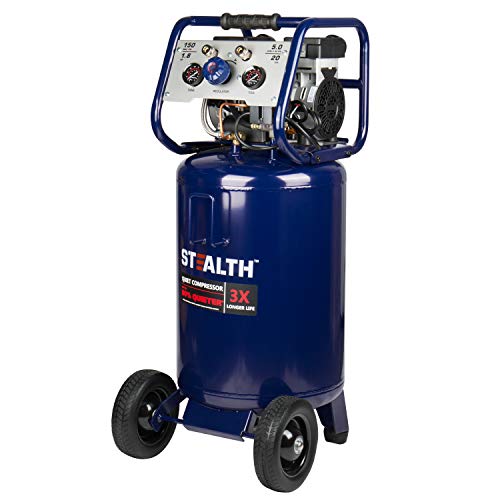
- 68 dB quiet operation
- 150 PSI peak pressure
- Two quick couplers and wheels
Best For: Garage projects needing mobile, higher-pressure air supply
Best Overall for Quiet Capacity – California Air Tools 8010A
For shoppers comparing quiet air compressors, the California Air Tools 8010A stands out with a relatively large 8-gallon aluminum tank and a 60 dBA operating level. Its oil-free pump, wheels, and 120 PSI maximum make it a practical choice for indoor tasks and general workshop use.
Best For: Users who want quiet, portable tank capacity for nailing, inflating, cleaning, air brushing, sanding, and spraying.
Pros:
- 60 dBA noise level suits indoor and noise-sensitive work areas.
- 8-gallon aluminum tank provides more reserve capacity than the smaller models here.
- Oil-free pump and wheel kit reduce maintenance and simplify movement.
- Reaches 120 PSI with a listed 60-second recovery from 90 to 120 PSI.
Cons:
- Its larger tank makes it less compact than the 2-gallon options.
- At 37.25 pounds, it is portable but not especially lightweight for carrying.
The 8010A is a strong all-around pick when low noise and longer run time matter more than the smallest possible footprint. Its 8-gallon capacity adds versatility for projects that would quickly cycle a compact compressor.
Best for Trim Work – DEWALT DWFP55130 Quiet Compressor
The DEWALT DWFP55130 is a compact option among quiet air compressors, pairing a 2.5-gallon tank with 200 PSI maximum pressure. Its thin design, roll cage, dual couplers, and ability to operate horizontally or vertically make it particularly convenient for trim and nailer work.
Best For: Trim carpenters and DIY users who need a compact compressor that can support two nailers.
Pros:
- 3.0 SCFM at 90 PSI supports quick recovery for trim applications.
- 200 PSI maximum pressure provides substantial stored pressure for its size.
- Dual quick couplers can support two nailers.
- Compact 12.5-inch-thick design stores vertically or horizontally.
Cons:
- At 71.5 dBA, it is louder than the 60 dBA models in this roundup.
- The 2.5-gallon tank offers less reserve capacity than the 8-gallon model.
- The supplied details list it at 36 pounds, so it is not an ultra-light carry.
The DWFP55130 prioritizes job-site convenience and nailer performance over minimum noise. Choose it when compact storage, high maximum pressure, and dual-tool support are more important than achieving the quietest operation.
Best Rugged Compact Pick – Makita MAC210Q Quiet Series
Makita MAC210Q Quiet Series, 1 HP, 2 Gallon, Oil-Free, Electric Air Compressor
Check Price On AmazonThe Makita MAC210Q is a compact member of the quiet air compressors category, operating at 60 dB with a 2-gallon tank and 135 PSI maximum. Its roll-cage construction and oil-free dual-piston pump make it well suited to portable work where equipment protection and low maintenance matter.
Best For: Job-site users who need a quiet, compact compressor for cutting, grinding, and spraying.
Pros:
- 60 dB operation helps reduce noise for operators and crews.
- Roll-cage construction protects key components during transport and storage.
- Oil-free pump is designed for maintenance-free operation.
- Lower 1,750 RPM operation is intended to support motor and pump life.
Cons:
- The 2-gallon tank has limited reserve capacity for extended air-demanding work.
- Its listed 1.6 CFM airflow is lower than the California Air Tools models.
- At 44 pounds, it is heavier than the other compact option listed here.
The MAC210Q makes sense for users who value a protected, job-site-ready build and quiet operation in a small format. Its airflow and tank size are better matched to intermittent use than sustained high-demand tools.
Best Fast-Recovery Compact Model – California Air Tools 2010A
The California Air Tools 2010A is a compact choice for shoppers seeking quiet air compressors with quick recovery. It combines 60 dBA operation, a 2-gallon rust-free aluminum tank, and a stated 14-second recovery from 90 to 120 PSI in a 35-pound portable package.
Best For: Air brushing, tire inflation, and small indoor projects where quiet operation and quick cycling are useful.
Pros:
- 60 dBA operation is suitable for indoor and noise-sensitive environments.
- Listed airflow reaches 2.20 CFM at 90 PSI and 3.10 CFM at 40 PSI.
- Fast 14-second recovery from 90 to 120 PSI supports efficient intermittent work.
- Oil-free pump and aluminum tank help reduce maintenance concerns.
Cons:
- The 2-gallon tank is not intended for long continuous air demand.
- It does not include wheels, unlike the larger 8010A.
- The supplied specifications show a maximum pressure of 120 PSI in the feature notes and 125 PSI in the details.
The 2010A is a compelling compact pick when quiet operation and rapid recovery matter more than tank size. It is especially well matched to short, repeated tasks that benefit from a portable, low-maintenance compressor.
Best Ultra-Quiet Compact Pick – Metabo HPT EC28M 1-Gallon Compressor
If you need quiet air compressors for finish work, trim projects, or general nailing, the Metabo HPT EC28M is a compact option rated at just 59 dB. Its 1-gallon oil-free tank, quick coupler, and lightweight frame make it easy to carry from one task to the next.
Best For: Home DIYers and professionals who prioritize very low noise, portability, and nailer-ready performance.
Pros:
- Operates at a notably quiet 59 dB, allowing normal conversation while cycling.
- At 25.2 pounds, it is relatively easy to transport around a jobsite.
- Universal quick coupler supports fast tool changes, while the oil-free design reduces maintenance.
Cons:
- The 1-gallon tank is better suited to nailing and intermittent tasks than extended high-air-demand work.
- Its listed 125 PSI maximum pressure does not indicate the larger reserve of a full-size tank.
The EC28M stands out when minimizing compressor noise and carrying weight matters more than tank capacity. It is a practical quiet air compressor for nailers and portable jobsite use.
Best Portable Versatility Pick – Stealth SAQ-1234 2-Gallon Compressor
The Stealth SAQ-1234 is one of the more versatile quiet air compressors in this group, combining a 2-gallon tank with 3/4 horsepower and a noise rating below 60 dB. Its 125 PSI output and included safety features suit inflation, nailing, airbrushing, and other home projects.
Best For: DIY users who want quiet operation with enough airflow for inflation, nailers, staplers, and light air-tool tasks.
Pros:
- Low-vibration operation produces noise as low as 60 dB.
- Provides 2.8 CFM at 40 PSI and 1.8 CFM at 90 PSI for quicker recovery during intermittent use.
- Oil-free construction, overheat protection, and a safety valve help simplify ownership.
- Supports varied applications including tire inflation, airbrushing, nailing, and stapling.
Cons:
- At 41.9 pounds, it is substantially heavier than the 1-gallon Metabo HPT model.
- The 2-gallon tank may still be limited for prolonged use with high-demand tools.
Choose the SAQ-1234 if you want a quiet compressor with more tank capacity and broader application support than a compact nailer-only model. Its airflow ratings make it a useful fit for intermittent DIY work.
Best Large-Tank Workshop Pick – Quiet 5-Gallon Oil-Free Compressor
For buyers who need more reserve than a compact compressor provides, this 5-gallon oil-free model combines 2.8 CFM at 90 PSI with a 68 dB operating rating. The included hose, accessories, and wheels make it a practical package for garage projects, woodworking, nailing, and inflation.
Best For: Workshops, garages, and jobsite users who need a larger tank and support for multiple pneumatic tools.
Pros:
- The 5-gallon tank offers more air reserve for intermittent pneumatic-tool use.
- Delivers 4 CFM at 40 PSI and 2.8 CFM at 90 PSI.
- Includes a 25-foot PVC hose and 13-piece air-tool accessory kit.
- Oil-free operation reduces routine maintenance, while the wheel kit improves mobility.
Cons:
- Its listed noise specification is 68 dB, so it is not as quiet as the smaller models in this roundup.
- The larger tank and wheel kit make it less compact for frequent carrying.
This model is the better match when tank capacity and tool compatibility outweigh the need for the lowest possible noise. Its accessory package and claimed fast refill and recovery times add convenience for repeated project work.
Best Compact Quiet Pick – Makita MAC320Q 3-Gallon Quiet Compressor
Makita MAC320Q Quiet Series 1-1/2 HP, 3 Gallon, Oil-Free, Electric Air Compressor
Check Price On AmazonFor indoor projects and smaller pneumatic tasks, the Makita MAC320Q is a practical choice among quiet air compressors. Its 60 dB Quiet Series design, compact 3-gallon tank, and lightweight build make it easier to use around crews, workshops, and job sites where noise and portability matter.
Best For: Indoor cutting, grinding, spraying, and other applications where compact portability and lower operating noise are priorities.
Pros:
- Quiet 60 dB operation is suited to noise-sensitive work areas.
- Lower 1,750 RPM operation is designed to support longer motor and pump life.
- Oil-free dual-piston pump provides maintenance-free operation.
- Roll-cage construction helps protect the compressor during transport and storage.
Cons:
- The 3-gallon tank is smaller than the tanks on the other compressors in this roundup.
- Its 135 PSI maximum pressure and compact capacity may be less suitable for extended high-demand tool use.
The MAC320Q stands out when quiet indoor operation and easy handling are more important than maximum air storage. It is a sensible compact option for users who want an oil-free compressor with job-site protection.
Best Large-Tank Value – California Air Tools 20020 20-Gallon Compressor
The California Air Tools 20020 combines a 20-gallon tank with a 70 dB noise rating, making it a strong option for users seeking quiet air compressors with more stored air for garage or shop work. Its oil-free pump, wheels, and 2 HP motor provide a useful balance of capacity, mobility, and lower maintenance.
Best For: Garage and job-site users who need a larger tank for nailing, spraying, and other intermittent pneumatic tasks.
Pros:
- 20-gallon steel tank provides substantially more air storage than compact models.
- 70 dB operation is designed for noise-sensitive environments.
- Oil-free dual-piston pump requires less maintenance and delivers cleaner air.
- Wheels and a 110-volt, 14-amp setup support practical shop or job-site use.
Cons:
- At 134 pounds, it is considerably less portable than a small compressor.
- The 45-inch height and 20-inch footprint require more storage space.
- Its 70 dB rating is quieter than many conventional compressors but not the quietest option here.
Choose the 20020 if tank capacity is a priority and you still want a relatively quiet, oil-free machine that works from a standard 110-volt outlet. Its wheeled design helps offset the heavier steel-tank construction.
Best High-Pressure Option – Stealth 20-Gallon Ultra Quiet Compressor
The Stealth SAQ-12018 is a versatile pick among quiet air compressors, pairing a 20-gallon tank with 68 dB operation and a 150 PSI peak rating. Its oil-free motor, wheeled steel tank, and two quick couplers make it suitable for a broad range of garage and workshop tasks.
Best For: Garage users who want a mobile 20-gallon compressor for nailing, sanding, spraying, tire inflation, and general pneumatic work.
Pros:
- 68 dB noise level provides quieter operation than many standard compressors.
- 150 PSI peak pressure and 5 CFM at 90 PSI support quick recovery.
- Oil-free motor reduces mess and routine maintenance.
- Two quick couplers make switching between tools more convenient.
Cons:
- The 121.4-pound steel-tank design is not easy to lift or carry.
- Its 20-gallon vertical form requires dedicated floor and storage space.
- It is louder than the 60 dB Makita model.
The Stealth offers a useful combination of high pressure, large capacity, and quieter operation. It is a compelling choice for garage users who need broad tool compatibility and mobility without moving up to a louder conventional compressor.
How We Picked the Best Quiet Air Compressors
We focused on models that prioritize lower operating noise without sacrificing useful workshop performance. Our comparison considered advertised decibel ratings, tank size, maximum pressure, airflow at 90 PSI, motor design, portability, and maintenance requirements. Oil-free pumps generally simplify ownership, while larger tanks and higher CFM ratings are better suited to extended or demanding tool use.
Because noise figures can vary with distance, surface, and operating conditions, treat decibel ratings as useful comparisons rather than exact guarantees. Tool compatibility is equally important: a compressor that is quiet enough for indoor use may still lack the airflow required by a high-consumption pneumatic tool.
Quick Comparison
| Best For | Recommended Type | What to Prioritize |
|---|---|---|
| Trim work and brad nailing | Compact 1- to 3-gallon model | Fast recovery, portability, and low noise |
| Inflation and light DIY tasks | Small oil-free compressor | Convenient storage and adequate maximum PSI |
| General workshop use | 5- to 8-gallon compressor | Balanced tank capacity and airflow |
| Longer tool sessions | 20-gallon compressor | Higher CFM, recovery speed, and duty cycle |
Key Buying Factors for Quiet Air Compressors
Noise Rating
Look for a published rating around 60 to 70 dBA if you plan to work indoors or near occupied spaces. Lower numbers are quieter, but pump vibration and the room’s acoustics also affect perceived noise.
Tank Size and Recovery
A larger tank provides a longer reserve before the motor restarts, which helps with intermittent tools. Smaller tanks are easier to carry and store but may cycle more often. Check recovery performance if you expect frequent nailing, stapling, or spraying.
Airflow and Tool Compatibility
Compare the compressor’s CFM at 90 PSI with your tool’s required CFM. Choose a model with some headroom rather than matching the numbers exactly. Nailers and inflators need relatively little airflow, while impact wrenches, grinders, and spray guns can require substantially more.
Portability, Power, and Maintenance
Confirm that the compressor works with your available electrical circuit and has a cord length and footprint suited to your workspace. Wheels and handles help with larger tanks. Oil-free pumps reduce routine maintenance, although they may not last as long as some oil-lubricated designs under heavy commercial use.
Who Should Buy Which Quiet Air Compressors?
Choose a compact one- or two-gallon unit if you mainly use brad nailers, finish nailers, staplers, air dusters, or inflation accessories. A five- to eight-gallon model is a better all-purpose choice for DIY users who want more reserve capacity without giving up portability.
For furniture building, trim installation, or frequent workshop projects, prioritize quiet operation, quick recovery, and a practical 90-PSI CFM rating. Buyers running impact tools or other high-demand equipment should step up to a larger tank and higher-output model, while checking the tool manufacturer’s airflow requirements first.
Finally, select a 20-gallon compressor when capacity and sustained performance matter more than easy carrying. Regardless of size, use the supplied regulator, drain condensation regularly, place the unit on a stable surface, and wear hearing and eye protection when operating pneumatic tools.