The best cordless rotary tools make detailed sanding, polishing, engraving, cutting, and craft work easier without tying you to an outlet. This roundup compares 10 compact options ranging from versatile 12V kits to lightweight mini tools.
Use the guide below to match voltage, speed control, accessories, runtime, and ergonomics to the projects you plan to tackle most often.
Best 10 Cordless Rotary Tools Picks for 2026
Power Pick
Dremel 8240 12V Cordless Rotary Tool

- 12V power with speeds up to 35,000 RPM
- 2Ah battery, charger, bag, and five accessories included
- Ergonomic grip and wrench-free accessory changes
Best For: Versatile DIY cutting, sanding, grinding, and polishing
Built-Tough Choice
Milwaukee 12V Cordless Rotary Tool

- 5,000–32,000 RPM variable-speed motor
- Compact 1.3-pound grinder-style design
- 1/8-inch collet and durability-focused construction
Best For: Compact workshop use and demanding DIY maintenance
Light-Duty Favorite
Dremel Lite 7760 4V Rotary Tool

- Lightweight 9.6-ounce cordless design
- USB charging and 8,000–25,000 RPM variable speed
- Includes 10 accessories and an accessory case
Best For: Light crafting, engraving, sanding, and polishing
Accessory-Rich Value
WORKPRO 12V Cordless Rotary Tool

- 114 accessories for sanding, engraving, polishing, and cutting
- 2Ah battery with five speeds up to 32,000 RPM
- Includes universal chuck, storage case, and carrying bag
Best For: DIYers and crafters wanting a broad starter kit
Precision Pick
Dremel 8150 8V Cordless Rotary Tool Kit

- Brushless 8V motor with 5,000–30,000 RPM control
- Built-in LED nose light for detailed work
- Compact grip with 20 included accessories
Best For: Precision DIY, engraving, crafting, and home repairs
Accessory-Heavy Pick
HARDELL 12V 94-Piece Rotary Tool Kit

- 12V motor with six speeds up to 30,000 RPM
- Includes 94 accessories for varied projects
- Two collets, case, and storage bag included
Best For: Broad DIY, repair, craft, and workshop applications
Best with Extra Features
HOTO 5-Speed Cordless Rotary Tool
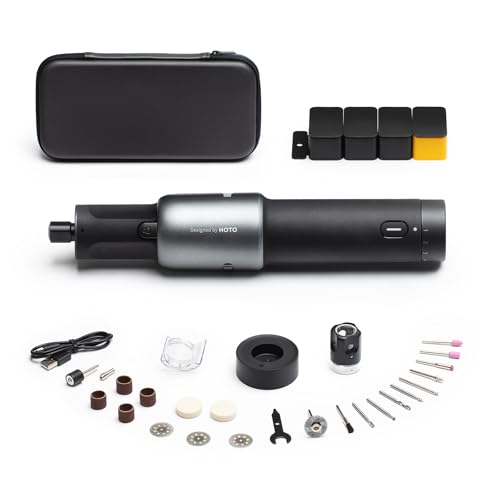
- 5,000–25,000 RPM across five speeds
- Pen-style body with LED and dust shield
- 35 accessories plus pet nail attachment
Best For: Precision DIY and 3D-print finishing
Best Accessory System
Fanttik F2 PRO Cordless Rotary Tool

- Five speeds up to 25,000 RPM
- 55 accessories with magnetic rotating storage
- 3,000mAh battery and work-status indicators
Best For: Versatile DIY projects and organized storage
Best Beginner Kit
HARDELL Mini Cordless Rotary Tool

- Five speeds from 5,000–18,000 RPM
- 69-piece kit with three collets
- Lightweight, quiet, and craft-friendly
Best For: Beginners and light resin or DIY projects
Power Pick – Dremel 8240 12V Cordless Rotary Tool
The Dremel 8240 is a strong all-around choice among cordless rotary tools, combining a 12V motor, 5,000–35,000 RPM variable speed, and a 2Ah lithium-ion battery. Its ergonomic grip, battery indicator, and wrench-free EZ Twist nose cap make it practical for extended cutting, sanding, grinding, and polishing sessions.
Best For: DIYers who want a capable, comfortable rotary tool for varied household and workshop tasks.
Pros:
- High 35,000 RPM maximum speed with a broad variable-speed range
- Includes a 2Ah battery, charger, five accessories, and fabric carry bag
- Comfortable 360-degree grip zone and battery-life indicator
- Compatible with Dremel accessories and attachments
Cons:
- The kit includes only five accessories
- Its 1.5-pound weight is higher than the lightweight Dremel Lite
Choose the 8240 when power, runtime, and accessory compatibility matter more than having the largest starter assortment. Ventilation openings also support cooler and quieter operation during longer jobs.
Built-Tough Choice – Milwaukee 12V Cordless Rotary Tool
The Milwaukee 12V rotary tool is a compact option for shoppers seeking durable cordless rotary tools with a grinder-style design. It offers variable speeds from 5,000 to 32,000 RPM, a 1/8-inch collet for common accessories, and a lightweight 1.3-pound body.
Best For: Users who prioritize compact handling, accessory compatibility, and a durability-focused construction.
Pros:
- Powerful motor designed to maintain performance under load
- 1/8-inch collet works with current rotary tool accessories
- Compact 9.5-inch design and 1.3-pound weight
- Protected front bearing and grinder-style exhaust ports support durability
Cons:
- The supplied kit components are limited compared with larger accessory kits
- Its 32,000 RPM maximum is slightly below the Dremel 8240
This Milwaukee is a sensible fit for buyers who already own compatible accessories or want a focused tool rather than a large starter kit. Its five-year tool warranty adds reassurance for regular use.
Light-Duty Favorite – Dremel Lite 7760 4V Rotary Tool
The Dremel Lite 7760 is one of the easiest cordless rotary tools to carry and charge, weighing just 9.6 ounces and using a rechargeable 4V battery with USB charging. Its 8,000–25,000 RPM range, soft grip, and 10 included accessories suit light-duty crafting, engraving, sanding, and polishing.
Best For: Crafters and DIY beginners handling light projects that value portability and simple charging.
Pros:
- Very lightweight design with a comfortable 360-degree soft grip
- USB charger and battery-life indicator simplify recharging
- Includes 10 accessories and an accessory case
- Wrench-free EZ Twist nose cap enables quick changes
Cons:
- Not recommended for cutting, drilling, or routing
- Lower 4V power and 25,000 RPM maximum suit light-duty work only
The Dremel Lite makes sense when maneuverability and convenience are more important than heavy-duty performance. For tougher cutting or drilling tasks, consider a higher-voltage model instead.
Accessory-Rich Value – WORKPRO 12V Cordless Rotary Tool
The WORKPRO 12V kit stands out among cordless rotary tools for its extensive 114-piece accessory selection. Its 2Ah lithium-ion battery powers five speed settings from 7,500 to 32,000 RPM, while the included universal chuck and two collets support a broad range of sanding, engraving, polishing, cutting, and drilling tasks.
Best For: DIY enthusiasts and crafters who want one starter kit for experimenting with multiple materials and accessories.
Pros:
- Includes 114 accessories in a storage case and carrying bag
- Five selectable speeds from 7,500 to 32,000 RPM
- 2Ah battery and 12V motor provide useful cordless power
- Lightweight 1.4-pound body with low vibration and sound claims
Cons:
- The large accessory assortment may be more than occasional users need
- Requires periodic recharging every three to six months during infrequent storage
Choose the WORKPRO when accessory variety is a priority. It offers a broad starting point for handmade projects and household maintenance, though buyers should confirm which included bits best match their specific materials and tasks.
Precision Pick – Dremel 8150 8V Cordless Rotary Tool Kit
For shoppers comparing cordless rotary tools, the Dremel 8150 stands out as a compact, capable option for detailed DIY work. Its brushless 8V motor, integrated battery, LED nose light, and 5,000–30,000 RPM variable-speed range support everything from engraving and polishing to sanding, grinding, and light cutting.
Best For: Makers, crafters, homeowners, and anyone who wants a versatile rotary tool for precision work and household repairs.
Pros:
- Brushless 8V motor with speeds from 5,000 to 30,000 RPM.
- Built-in LED light helps illuminate detailed or low-light work areas.
- Compact, pencil-like grip is suited to engraving and detail sanding.
- Includes 20 accessories and works with Dremel accessories and attachments.
Cons:
- Its integrated battery is not described as removable.
- The included 20-piece accessory selection is smaller than some larger kits.
The 8150 is a strong all-around choice when comfort, visibility, and controlled speed matter more than a very large accessory bundle. USB-C charging and a two-year limited warranty add everyday convenience.
Ultra-Light Choice – Fanttik F2 Master Mini Rotary Tool Kit
Among cordless rotary tools, the Fanttik F2 Master is designed for portable, precision-focused tasks. It weighs just 0.22 pounds, uses five adjustable speed settings up to 25,000 RPM, and includes a rotating magnetic hub that keeps its 35 small accessories organized.
Best For: 3D-print finishing, model work, engraving, polishing, and other lightweight precision projects.
Pros:
- Very light 0.22-pound design for portable detailed work.
- Five speed settings and an LED speed indicator support controlled operation.
- Includes 35 accessories with a 360-degree rotating magnetic storage hub.
- USB-C charging reaches a full charge in about 60 minutes.
Cons:
- Its 3/32-inch (2.3 mm) collet limits compatibility to matching accessories.
- The sealed, pre-assembled battery is not removable.
- Its 12,000–25,000 RPM range is narrower than some general-purpose rotary tools.
The F2 Master makes the most sense when portability, organized accessories, and quieter operation are priorities. Its compact format is convenient for fine work, though the smaller collet and limited battery runtime of about 60 minutes make it less suited to extended heavy-duty projects.
Accessory-Heavy Pick – HARDELL 12V 94-Piece Rotary Tool Kit
For buyers who want cordless rotary tools with a broad range of included bits, the HARDELL 12V kit offers 94 accessories and six speed settings from 5,000 to 30,000 RPM. It is equipped for sanding, polishing, engraving, grinding, drilling, carving, cutting, and general household projects.
Best For: DIYers who want one versatile kit for crafts, repairs, model making, jewelry polishing, and light workshop tasks.
Pros:
- 12V cordless motor provides useful power for everyday DIY projects.
- Six speed settings cover delicate polishing through higher-speed sanding and grinding.
- 94 accessories include cutting discs, drill bits, sanding bands, grinding stones, and polishing wheels.
- Two collets, an accessory case, and a fabric bag improve organization and portability.
Cons:
- At 1.1 pounds, it is heavier than the Fanttik mini tool.
- The extensive accessory set may be more than occasional users need.
- The supplied notes do not specify a charging time or battery runtime.
The HARDELL is a practical value-oriented option for users who want broad task coverage without buying accessories separately. Its rubberized grip and balanced design should help during longer projects, while the two collets expand accessory compatibility.
Best with Extra Features – HOTO 5-Speed Cordless Rotary Tool
For detailed DIY work, the HOTO is one of the more polished cordless rotary tools to consider. Its pen-style body, five speed settings from 5,000 to 25,000 RPM, built-in LED, and included dust shield make it suited to controlled sanding, polishing, carving, cutting, and 3D-print finishing.
Best For: Precision DIY, 3D-print finishing, light engraving, polishing, and pet nail grinding.
Pros:
- Five clearly stepped speeds support both delicate detailing and faster material removal.
- Compact, ergonomic design with quiet, low-vibration operation helps reduce hand fatigue.
- Includes 35 accessories, USB-C charging, a charging base, storage pouch, LED light, and dust shield.
Cons:
- The 4V design is aimed at precision and light DIY work rather than heavy-duty grinding.
- The accessory set may require checking collet compatibility for specialized attachments.
The HOTO stands out when comfort, appearance, and control matter more than maximum workshop power. Its accessory range and pet nail attachment add versatility for home users.
Best Accessory System – Fanttik F2 PRO Cordless Rotary Tool
The Fanttik F2 PRO is a strong option among cordless rotary tools for users who want organized accessories and clear operating feedback. It combines five speeds from 5,000 to 25,000 RPM with a high-efficiency magnetic motor, front LED, battery indicator, and a rotating accessory storage hub.
Best For: DIYers who want a broad accessory selection for polishing, rust removal, sharpening, engraving, and cutting.
Pros:
- Includes 55 accessories in an aluminum alloy case with a rotating magnetic holder.
- Three thousand mAh battery is rated for approximately 20–120 minutes depending on speed and material.
- Front LED, rear low-battery indicator, and side speed display provide useful work feedback.
Cons:
- Run time varies substantially with the selected speed and task.
- The larger accessory system may be more than needed for simple, occasional projects.
Choose the F2 PRO if storage and accessory variety are central to your buying decision. Its organized case and visual indicators make it particularly appealing for a flexible home DIY setup.
Best Beginner Kit – HARDELL Mini Cordless Rotary Tool
The HARDELL Mini is a compact choice for beginners exploring cordless rotary tools. Its lightweight, pen-like design, five speed settings from 5,000 to 18,000 RPM, LED lighting, and 69-piece accessory kit make it practical for resin crafts, sanding, carving, polishing, and other light DIY work.
Best For: Beginners, resin and 3D-print crafts, family DIY projects, and light detailing.
Pros:
- Five adjustable speeds make it easier to control delicate work in stages.
- Lightweight, low-noise design offers comfortable handling and precise control.
- Includes 69 accessories, three collets, LED lighting, and a rechargeable battery rated for up to 200 minutes of continuous use.
Cons:
- It is explicitly not intended for heavy-duty projects.
- Its maximum speed of 18,000 RPM is lower than the 25,000 RPM offered by the other listed tools.
The HARDELL makes the most sense for craft-focused users who value a generous starter kit and approachable controls. For demanding material removal, a more powerful model would be a better fit.
How We Picked the Best Cordless Rotary Tools
We focused on tools that balance useful power, controllable speed, portability, and practical accessories. The selected kits cover several common use cases, including household repairs, woodworking, crafts, model making, 3D-print finishing, polishing, and light cutting.
We also considered battery voltage, speed-range flexibility, included attachment counts, charging convenience, grip size, and whether each tool is better suited to precision work or heavier-duty tasks. Accessory quantity matters, but compatibility and quality are usually more important than a large piece count.
Quick Comparison
| What to Compare | Best For |
|---|---|
| 4V to 5V mini tools | Light sanding, polishing, crafts, and detail work |
| 8V to 12V tools | Broader DIY use and more demanding materials |
| Variable speed | Switching between delicate and aggressive tasks |
| Larger accessory kits | Users who want to start with multiple attachments |
| Compact pen-style designs | Comfort, control, and 3D-print finishing |
Key Buying Factors for Cordless Rotary Tools
Power and Battery Capacity
Voltage is a useful starting point, but it does not tell the whole story. Lower-voltage models are often lighter and easier to control, while 8V and 12V tools generally offer more headroom for cutting, grinding, and extended DIY use. Check charging time and expected runtime if you work away from a bench.
Speed Control
Multiple speed settings are important because different materials require different approaches. Low speeds help with polishing, plastic, and delicate surfaces; higher speeds are useful for grinding, cutting, and tougher wood. A tool with five or more settings can be more versatile than one with only a basic high-low switch.
Chuck and Accessory Compatibility
Look for a secure collet or chuck and confirm that the included accessories fit the jobs you expect to do. Sanding drums, grinding stones, polishing wheels, cutting discs, burrs, and engraving bits each serve different purposes. A universal accessory format can make future replacements easier to find.
Ergonomics and Safety
A comfortable grip, manageable vibration, LED lighting, and a clear speed control can make precision work substantially easier. Wear eye protection, avoid forcing the bit, secure the workpiece, and use appropriate respiratory protection when generating dust.
Who Should Buy Which Cordless Rotary Tools?
Choose a compact 4V or mini rotary tool if you mainly finish 3D prints, polish small parts, work on crafts, or need a lightweight tool for occasional detail work. An 8V model is a sensible middle ground for mixed household and hobby tasks. A 12V kit is usually the better choice for frequent DIY projects, heavier sanding, cutting, and users who want stronger performance.
If you are new to rotary tools, prioritize variable speed, a comfortable grip, and a well-rounded accessory selection over the highest advertised RPM. Experienced users may prefer a stronger motor, better runtime, interchangeable accessories, and a kit that complements the bits they already own.