Finding a cable machine that accommodates a taller frame takes more than checking its weight stack. Frame height, pulley travel, bench clearance, and available training space all affect whether exercises feel natural and unrestricted.
We compare 10 functional trainers for tall people, ranging from compact home systems to commercial-style all-in-one gyms, so you can choose equipment that fits both your body and your room.
Best 10 Functional Trainers for Tall People Picks for 2026
Compact Choice

- 82-inch height with a compact 40-inch width
- Dual 165-pound weight stacks
- Includes pull-up bar and four accessory types
Best For: Tall users wanting substantial cable training in a space-conscious home setup
Commercial-Size Pick

- 86-inch height suits a larger training environment
- 400-pound weight stacks and 24 attachments
- Combines functional, Smith, cage, bench, and leg-press stations
Best For: Tall users with ample space who want an all-in-one strength station
Adjustable Home Option

- 83-inch height with dual cable stations
- 24 micro-adjustments for precise loading
- 200-pound combined weight stacks with 2:1 ratio
Best For: Tall home-gym users prioritizing gradual resistance adjustments
Wide-Frame Favorite
Body-Solid Powerline Crossover

- 83-inch height with a wide 62.6-inch frame
- Dual independent 160-pound weight stacks
- 10-year frame and one-year parts warranties
Best For: Tall users wanting a sturdy, wide cable crossover for full-body training
Best Overall
REP Fitness Arcadia Functional Trainer
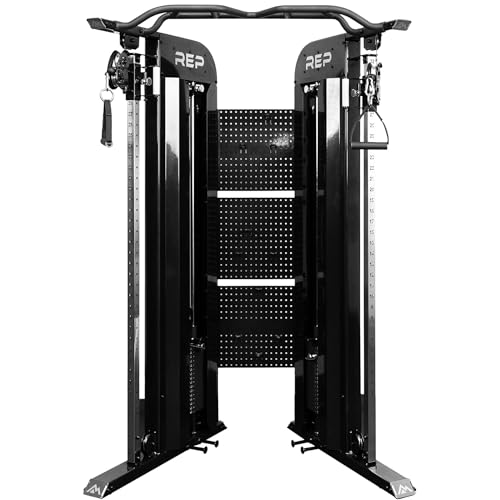
- 32 cable positions with high and low handle range
- 170-lb stacks, upgradeable to 220 lb per side
- Built-in storage and integrated band pegs
Best For: Home and garage gyms needing flexible cable positioning
Best Tall-User Clearance
Commercial Functional Trainer Cable Machine

- 94-inch height for greater overhead clearance
- 400 lb total dual-stack resistance
- Includes power cage and multi-grip pull-up station
Best For: Tall lifters with spacious home gyms
Best for Comfort

- 33 vertical positions and 165 pulley adjustments
- Compact 81.5-inch-high design
- 160-lb stack with frictionless pulleys
Best For: Space-conscious home gyms needing versatile cable training
Best Tall-User Cable Trainer
XMARK Dual-Stack Functional Trainer

- 90-inch frame suits taller users and overhead exercises.
- Dual 230-pound stacks operate independently.
- 21 height positions with a compact 61.5-by-33-inch footprint.
Best For: Tall users wanting a dedicated, heavy-duty cable machine
Best All-in-One Pick
LYAN HANS Commercial Functional Trainer
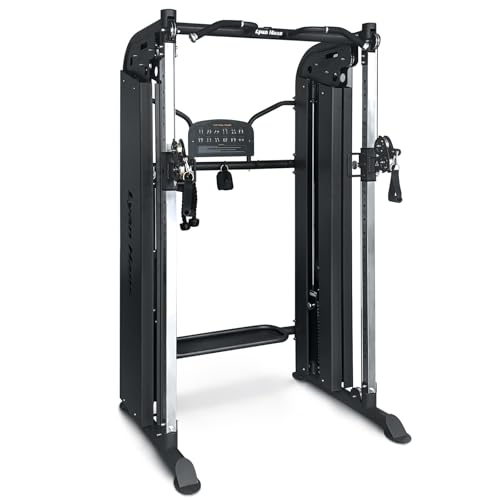
- Combines cable training with a power cage and squat rack.
- Dual 200-pound stacks support independent workouts.
- Multiple pull-up grips and 20 cable-height adjustments.
Best For: Home gyms needing one versatile rack-and-cable station
Best Multi-Station System

- Combines a Smith machine, rack, cables, and 10 training stations.
- 87-inch frame fits many taller-user setups with proper clearance.
- Dual 132-pound stacks and included attachments expand exercise options.
Best For: Users wanting a complete multi-function home gym
Compact Choice – FTX Functional Trainer
For functional trainers for tall people, the FTX is a relatively compact option with an 82-inch height and a 40-inch width. Its dual 165-pound stacks, pull-up bar, sliding pulleys, and included attachments support a broad range of home workouts without the footprint of a larger commercial station.
Best For: Tall users seeking a space-conscious home functional trainer with substantial cable resistance.
Pros:
- 82-inch height accommodates a taller setup than many compact trainers.
- Dual 165-pound weight stacks provide up to 330 pounds of supported tension.
- Includes a pull-up bar, storage rack, phone or tablet space, and four accessory types.
- Smooth-gliding pulleys are designed for friction-free movement.
Cons:
- The 82-inch height may still require careful ceiling clearance planning.
- At 544 pounds, it is a substantial piece of equipment to position.
The FTX stands out when floor space matters but you still want a serious dual-stack trainer. Check the available ceiling height and surrounding workout clearance before buying.
Commercial-Size Pick – Hercules EX All-in-One Gym
Among functional trainers for tall people, the Hercules EX offers the most imposing frame in this group, standing 86 inches high with a 77-inch depth. It combines a functional trainer with a Smith machine, power cage, leg press, bench, and multiple stations for users who have room for a comprehensive strength-training setup.
Best For: Tall users building a spacious home or commercial-style gym around one highly versatile station.
Pros:
- 86-inch height and large frame provide a substantial training platform.
- Combines functional training, Smith-machine work, power-cage exercises, leg press, and more.
- Includes 400-pound weight stacks and 24 accessories.
- Supports more than 300 listed exercises and has a lifetime frame warranty.
Cons:
- Its 77-inch depth and 67-inch width require extensive floor space.
- At roughly 980 pounds gross weight, delivery and assembly are demanding.
- Weight plates are not included.
The Hercules EX is better viewed as a full gym centerpiece than a simple cable machine. Its size and multi-package delivery make space, assembly, and installation planning essential.
Adjustable Home Option – Marcy MFT-942 Trainer
The Marcy MFT-942 is a practical candidate among functional trainers for tall people, with an 83-inch height and dual cable stations. Its 2:1 pulley ratio, 24 micro-adjustments, and 200 pounds of combined stack resistance make it suitable for controlled progression across upper- and lower-body exercises.
Best For: Tall home-gym users who value fine resistance adjustments and a straightforward dual-stack design.
Pros:
- 83-inch height gives taller users a useful starting point for cable training.
- Offers 24 micro-adjustments for more precise resistance changes.
- Includes adjustable handles, triceps rope, ankle strap, and curl bar.
- Built-in hooks help organize the included accessories.
Cons:
- The 200-pound total stack capacity is lower than the FTX and Hercules EX.
- The listing identifies an additional 50-pound weight as optional.
- A 2:1 ratio may provide less effective resistance at the handle than a 1:1 system.
The MFT-942 emphasizes smooth operation and incremental adjustments rather than maximum loading. Confirm ceiling clearance and decide whether its optional extra weight meets your long-term training needs.
Wide-Frame Favorite – Body-Solid Powerline Crossover
The Body-Solid Powerline is a wide dual-stack crossover that stands 83 inches tall, making it worth considering among functional trainers for tall people. Independent stacks support isolateral movements, while the high- and low-pulley layout covers cable crossovers, presses, rows, pull-ups, and numerous accessory exercises.
Best For: Tall users who want a sturdy, wide cable crossover for varied full-body training.
Pros:
- 83-inch height and 62.6-inch width create a broad cable-training area.
- Dual independent 160-pound stacks support isolateral movements.
- Handles high- and low-pulley exercises for nearly every major muscle group.
- Includes a 10-year frame warranty and one-year parts warranty.
Cons:
- The extra-wide frame needs more floor space than compact trainers.
- The 1/2:1 ratio delivers lighter effective resistance at the handle.
- The supplied listing does not specify a broad accessory package beyond the functional trainer.
The Powerline is a sensible choice when independent cable work and a wide training area matter more than a compact footprint. Measure both width and ceiling clearance before installation.
Best Overall – REP Fitness Arcadia Functional Trainer
For shoppers comparing functional trainers for tall people, the REP Fitness Arcadia offers an 80.8-inch height, 32 cable positions, and handles that adjust high and low to support a broad range of movements. Its dual stacks and upgrade options also give it room to grow with your training.
Best For: Home and garage gym users who want adjustable cable positioning, substantial resistance, and a customizable setup.
Pros:
- 32 cable positions help accommodate varied exercises and movement paths.
- Dual 170-pound stacks can be upgraded to 220 pounds per side.
- Built-in storage, integrated band pegs, and broad attachment compatibility improve versatility.
Cons:
- The 80.8-inch height may still require careful ceiling-clearance planning for taller users.
- Attachment packages beyond the included D-handles are optional.
The Arcadia is a strong all-around choice when adjustability matters most. Its high and low cable range is useful for taller trainees, while the stack upgrades and accessory compatibility support progressive, full-body workouts.
Best Tall-User Clearance – Commercial Functional Trainer Cable Machine
Among functional trainers for tall people, this commercial-style unit stands out with its 94-inch height and spacious 50-by-67-inch footprint. It combines a cable machine, power cage, crossover station, and pull-up station for users who want substantial training clearance and an all-in-one setup.
Best For: Taller lifters with enough room for a heavy, commercial-style home gym station and integrated rack training.
Pros:
- 94-inch height provides more overhead clearance than the other listed options.
- Dual 200-pound stacks deliver 400 pounds of total listed resistance.
- Combines cable training, a power cage, and a reversible multi-grip pull-up bar.
Cons:
- At 765 pounds, it is difficult to move or reposition after installation.
- The 50-by-67-inch footprint requires considerable floor space and ceiling height.
This is the clearest fit for tall users who prioritize vertical space and a full rack-and-cable system. Confirm both delivery access and room dimensions before ordering, since its commercial-scale weight and size are substantial.
Best for Comfort – Centr 1 Functional Trainer
The Centr 1 is a practical choice for shoppers seeking functional trainers for tall people without a commercial-size footprint. Its 81.5-inch height, 33 vertical positions, and 165 pulley adjustments provide exercise flexibility while keeping the design relatively compact for a home gym.
Best For: Home users who want a space-conscious functional trainer with many pulley adjustments and moderate resistance.
Pros:
- 33 vertical positions and 165 pulley adjustments support hundreds of exercises.
- Compact, low-profile design fits more easily into indoor training spaces.
- Industrial-grade steel construction and a limited lifetime warranty support long-term use.
Cons:
- The 81.5-inch height offers less overhead clearance than the 94-inch option.
- The 160-pound weight stack is lighter than the stacks on the other listed trainers.
The Centr 1 balances adjustability and footprint well, making it appealing when space is limited. Taller users should measure ceiling clearance carefully, but its extensive pulley positioning can still accommodate varied full-body training.
Best Tall-User Cable Trainer – XMARK Dual-Stack Functional Trainer
For shoppers comparing functional trainers for tall people, the XMARK stands out with a 90-inch frame and cable positions reaching 75.5 inches. Its dual 230-pound stacks, independent sides, and compact footprint make it a practical choice for serious home-gym training where ceiling height permits.
Best For: Taller lifters who want a dedicated dual-stack functional trainer for full-body cable work in a room with at least a 93-inch ceiling.
Pros:
- Dual 230-pound weight stacks provide 460 pounds of total stack capacity.
- Twenty-one cable-height positions and 87.5 inches of cable travel support varied exercises.
- Built-in multi-grip pull-up bar adds bodyweight training options.
- Frames arrive 98% pre-assembled, with cables already routed.
Cons:
- Its 90-inch height requires a room with a 93-inch ceiling.
- Freight delivery and two-person assembly are recommended.
- Only two handles are included.
The XMARK is one of the more directly height-conscious options here, pairing a tall frame with substantial stacks and smooth cable adjustment. Confirm both ceiling clearance and delivery logistics before ordering.
Best All-in-One Pick – LYAN HANS Commercial Functional Trainer
The LYAN HANS is a versatile option among functional trainers for tall people, although its 85.35-inch height is lower than the XMARK’s. It combines a cable crossover, power cage, squat rack, and pull-up station, making it useful when one machine needs to cover most home-gym movements.
Best For: Lifters who want an all-in-one rack and cable system with multiple pull-up grips and adjustable cable angles.
Pros:
- Integrates a power cage, cable crossover, squat rack, and pull-up station.
- Dual 200-pound stacks allow independent training and quick weight changes.
- Twenty height adjustments accommodate different exercise angles.
- Commercial-grade 2-by-2-inch steel uprights support a heavy-duty setup.
Cons:
- Its 85.35-inch height may provide less overhead clearance for very tall users.
- The 747-pound machine is heavy and measures about 50.12 by 43.88 inches.
- A 1-year warranty is shorter than the Mikolo’s listed 2-year warranty.
This model offers the broadest rack-and-cable combination of the three, but taller buyers should measure ceiling height and available floor space carefully. Its 2:1 resistance ratio also means the stack load is not the same as direct cable resistance.
Best Multi-Station System – Mikolo Smith Machine Trainer
For taller lifters seeking functional trainers for tall people with several strength stations, the Mikolo provides an 87-inch frame and a broad all-in-one layout. It combines a Smith machine, power rack, functional trainer, lat pulldown, low row, and additional stations within a 56-by-68-inch footprint.
Best For: Users who prioritize a complete multi-station home gym over the heavier cable stacks found on dedicated functional trainers.
Pros:
- Integrates 10 training stations, including a Smith machine, rack, functional trainer, and leg press.
- Dual 132-pound stacks provide independent cable training.
- Seamless lat pulldown and low-row transitions do not require carabiner adjustments.
- Includes 10-plus attachments, weight storage pins, and attachment hooks.
Cons:
- The 264-pound total cable capacity is lower than the other two machines’ listed stack capacities.
- Its 87-inch height still requires careful ceiling-clearance planning.
- The 68-inch depth creates a larger floor-space commitment than a compact cable-only trainer.
The Mikolo is the most comprehensive choice for users who want rack, Smith-machine, pulley, and accessory training in one system. Its lower stack capacity makes it better suited to versatility-focused buyers than those seeking maximum functional-trainer loading.
How We Picked the Best Functional Trainers for Tall People
We focused on the features that matter most to taller lifters: overall frame height, usable cable range, pulley adjustability, attachment selection, weight capacity, stability, and the amount of room needed around the machine. We also considered whether each system supports common movements such as lat pulldowns, rows, presses, squats, cable flyes, curls, and rotational exercises.
Because product specifications and configurations can vary, verify the current dimensions, included attachments, weight-stack size, cable ratio, and ceiling requirements before ordering. A machine that looks compact may still need substantial clearance for overhead exercises and plate or weight-stack access.
Quick Comparison
| What to Compare | Why It Matters for Taller Users |
|---|---|
| Frame and ceiling height | Reduces the risk of crouching, limited overhead movement, or installation problems. |
| Cable travel | Determines how freely you can perform presses, pulls, flyes, and unilateral exercises. |
| Pulley adjustment range | Helps align handles with your shoulders, chest, hips, and legs. |
| Weight ratio | A 2:1 ratio gives smoother, longer travel; a 1:1 ratio generally provides more resistance at the handle. |
| Footprint and clearance | Accounts for the machine plus the space needed to step back, extend your arms, and load accessories. |
Key Buying Factors for Functional Trainers for Tall People
Check Usable Height, Not Just Advertised Height
Overall dimensions are a starting point, but the position of the top pulleys and the distance between the floor and cable endpoints matter more during training. Look for enough overhead clearance for standing presses, pulldowns, and overhead triceps work. If your ceiling is low, measure both the assembled machine and the space needed to carry it into the room.
Prioritize Cable Travel and Adjustment Points
Taller users often benefit from long cable travel and a wide vertical adjustment range. Dual adjustable pulleys should move high enough for overhead work and low enough for rows, deadlift variations, and low cable exercises. Smooth travel is useful, but it should not come at the expense of stability.
Evaluate Stability, Attachments, and Training Space
A tall athlete may generate greater leverage, making a heavy, well-braced frame especially valuable. Consider whether the unit can be bolted down and whether it includes a pull-up bar, low row station, lat seat, handles, ankle straps, and safety accessories. Leave room behind and beside the machine so your stance and range of motion are not restricted.
Match Resistance and Footprint to Your Goals
Weight-stack systems are convenient and quick to change, while plate-loaded designs can offer flexibility and lower upfront cost. Compact trainers suit smaller rooms, but commercial-style systems usually provide more stability and accessory options. Confirm the maximum resistance at the handle rather than relying only on the advertised stack weight.
Who Should Buy Which Functional Trainers for Tall People?
Choose a compact functional trainer if you have limited floor space but still want adjustable cables for general strength training. Measure your ceiling and allow extra clearance before choosing a short-frame model.
Choose a heavy-duty commercial-style trainer if you are tall, train frequently, share the machine with other lifters, or want maximum stability for heavier pressing and pulling.
Choose an all-in-one system if you want a cable crossover combined with a rack, bench, lat pulldown, leg station, or other strength-training functions. These machines can replace several pieces of equipment, but they require more space and careful assembly.
Choose a dual-stack adjustable system if you primarily perform functional and unilateral movements. Independent cables make it easier to train each side separately and adjust the setup to your height.
Before buying, compare the machine’s assembled dimensions with your own reach, ceiling height, and available workout area. For taller users, a slightly larger trainer that allows full range of motion is usually a better long-term value than a compact unit that forces awkward positioning.